The place
How Benagil cave formed
Why a sea cave with a hole in its roof appeared in the Algarve cliffs, what limestone and the sea did to it, and why this cave is unusual on the coast.
Book the Benagil boat tour ↗A cave cut from two sides
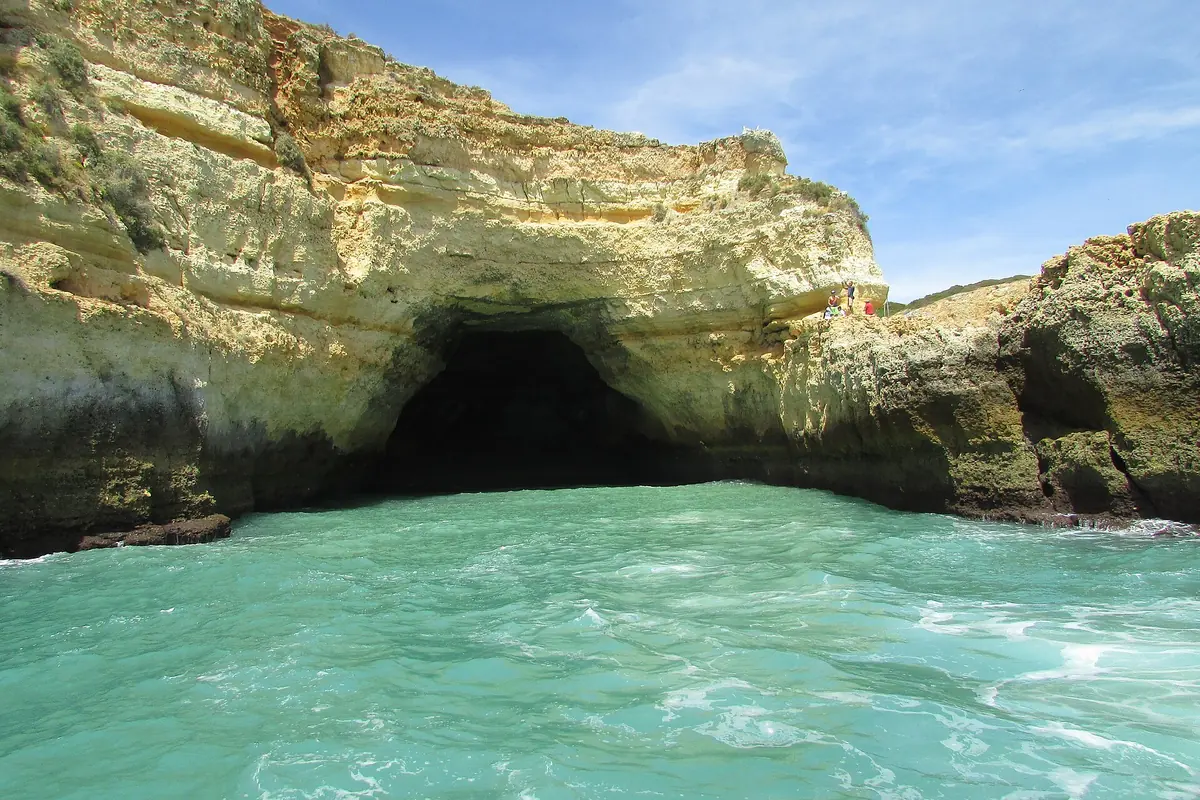
Wikipedia describes Benagil cave as the only sea cave between Lagos and Albufeira that has been eroded both from the side and from the top. That one sentence explains why the cave looks as it does. The sea cut a tunnel into the cliff from the side, as it has done in many places along this coast. A second process opened the roof from above. The two openings meet in one chamber, and sunlight drops through the upper one onto the beach the lower one feeds.
Limestone and the sea
The cliffs along this stretch of the Algarve are limestone, and a geology image page from the European Geosciences Union describes the Benagil coast as limestone cliffs with karst landforms. Differential erosion is the main process: softer or weaker layers wear away faster than harder ones, leaving openings and cavities in the cliff. Over a long time, such hollows become caves.
What the geology page adds
The European Geosciences Union page on the Benagil karst explains the cave in plain terms: differential erosion, in which softer rock layers are worn away faster than more resistant ones, creates openings and cavities in the cliffs. It labels the setting karst, the word geologists use for landscapes shaped by water working on soluble rock such as limestone. For a visitor, the useful point is that the cave is not an isolated accident. It is one result of a process that is visible all along the coast, in small hollows, ledges and arches as well as in the large chamber.
The roof opening
The opening in the ceiling is the unusual part. Wikipedia credits erosion from the top as well as the side, and says this unique natural process produced an opening that lets sunlight brighten the grotto and the beach it hides. Seen from inside, the opening shows as a bright round patch of sky, with the layered rock curving up around it.
The colour of the cliffs
In photographs of the cave you see bands of cream, gold and orange curving around the opening. The layering is visible in the rock around the roof hole and in the cliff outside. Wikipedia describes Marinha beach, a little further east, as bordered by orange limestone cliffs, and the warm colour runs along much of this stretch of coast, which is why boat trips here are often described as running past golden cliffs.
Other caves on the same coast
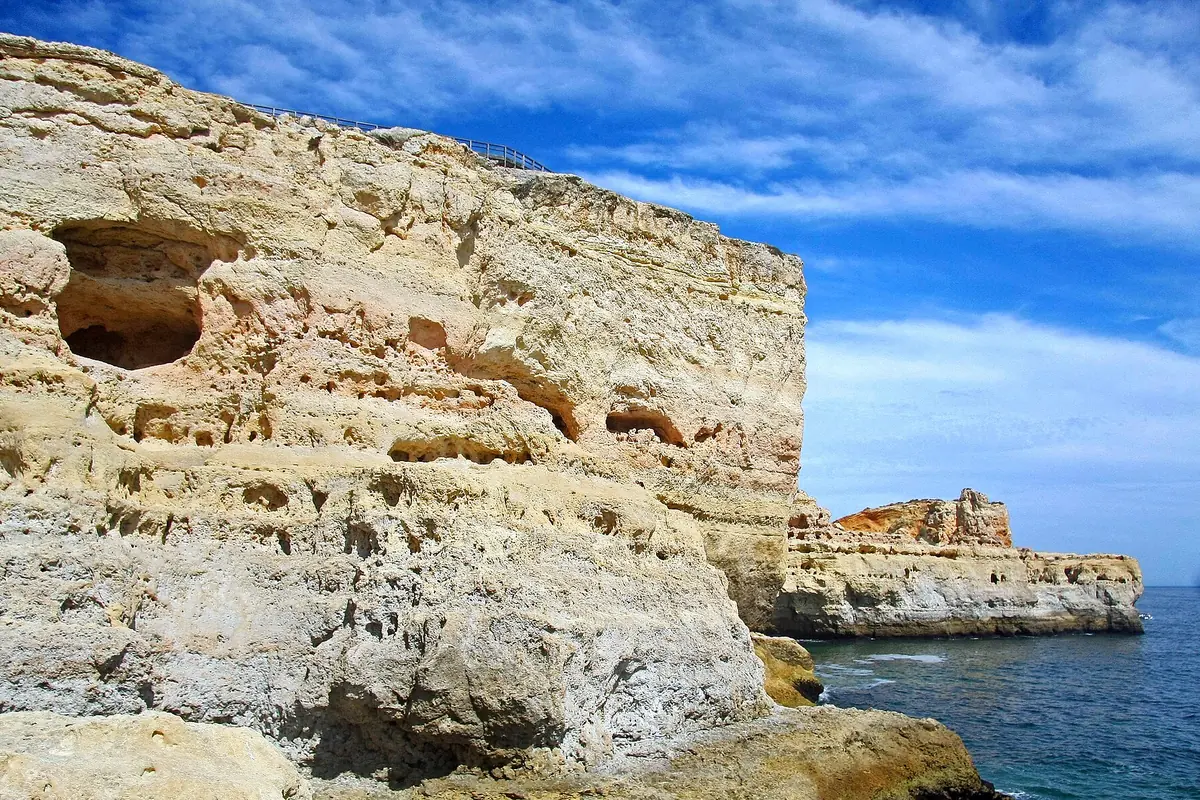
Benagil is not alone. Wikipedia says wave erosion has carved Algar Seco, near Carvoeiro, into grottoes, islets and water spouts, and the photographs in this guide show arches and stacks at Marinha. Many smaller caves line the cliffs between them. A boat tour passes several of these before reaching Benagil, which is a good reason to treat the tour as a coast trip and not a single-cave visit. Seeing a few ordinary caves first also makes the roof opening easier to appreciate.
Why the rules exist
The beauty of the cave is also its problem. Wikipedia reports that concerns about overtourism and safety led to regulations from 2023, and that only sanctioned tours are permitted in the grotto, with watercraft no longer allowed to land on the beach. Portugal's National Maritime Authority published navigation rules in 2024 that set limits on access. The rules set limits on how many boats can be in the cave and for how long, which is why visits are short. A boat trip that is short, regulated and limited in numbers is simply the form the visit now takes.
Sources